


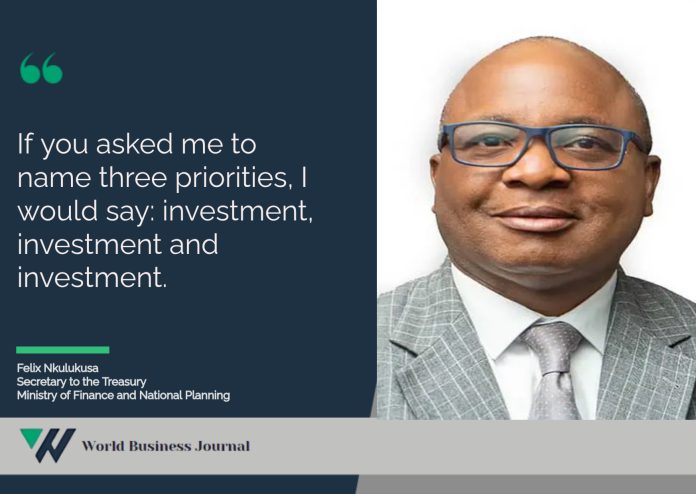
Felix Nkulukusa on Zambia’s Next Economic Priorities as Debt Restructuring Nears Completion
World Business Journal talks to Felix Nkulukusa, Secretary to the Treasury at the Ministry of Finance and National Planning, Republic of Zambia, about the lessons from Zambia’s debt restructuring process, now 94% complete, the financing of the country’s next economic priorities, with a focus on infrastructure and productive sectors, as well as efforts to deepen domestic capital markets and expand access to finance for local enterprises.
Where does Zambia’s debt restructuring process now stand, and what key lessons have emerged from the process?
We are now 94% through the debt restructuring process, with the remaining 6% expected to be finalised this year.
First, transparency must underpin trust. It is not a concession to creditors, but a sovereign tool for credibility. Borrowers and creditors alike must be clear about what is being borrowed or lent, and why.
To advance this, we undertook structural reforms. The Debt Management Act now requires an annual borrowing plan to be submitted to the National Assembly before the budget is prepared, setting out what we intend to borrow and why. We also publish quarterly debt statistics showing what was borrowed, how it was used and its impact, strengthening parliamentary oversight. As part of the same transparency drive, the Debt Management Act now caps borrowing at 65% of GDP, with a five-year transition period to bring debt down to that level, as it was already above the limit when the law was passed.
Second, simplicity matters. We had accumulated guarantees, collateralised loans and structured instruments that proved difficult to manage during restructuring. We are now looking at simpler approaches to borrowing.
Third, we must find better ways to leverage the balance sheets of multilateral institutions, especially African based ones, so that we can continue to borrow on concessional terms.
Fourth, we need to develop and strengthen our domestic markets so that we can rely on them in times of challenge.
What are the government’s key priorities for accelerating growth and investment?
We identified four priority growth sectors: manufacturing, agriculture, mining and tourism, supported by enablers such as human development and energy.
The drought highlighted the need to expand capacity, particularly given our targets of 10 Mt of maize and 3 Mt of copper. Under the energy compact signed with the World Bank and African Development Bank in January 2025, reaching 10,000 MW requires about $11B in investment, including $9.6B from private-sector generation. Since the drought, around 1,400 MW has been added to capacity, from just under 2,000 MW.
Transport and logistics are also critical. We are advancing the Lobito Corridor with the Democratic Republic of Congo and Angola, while developing the north-south route through Zambia Railways to South Africa. The European Union has allocated about $50M in its 2026 budget, matched by government funding, to help make the route commercially viable.
Road infrastructure is also being upgraded through public-private partnerships, including the Lusaka-Copperbelt road, without treasury funding. Together, these investments in energy, infrastructure and human development are intended to raise productivity and attract investment.
Under our next programme with the IMF, the focus is on unlocking private-sector investment. If you asked me to name three priorities, I would say: investment, investment and investment.
How is the government working with financial institutions and development partners to strengthen Zambia’s capital markets, improve access to credit, and ensure that local enterprises can participate more fully in the economy?
In agriculture, we have partnered with cooperating partners to establish a sustainable agriculture financing facility for small and medium-scale farmers. Through the World Bank’s Zambia Agriculture and Trade Program, we have also appointed a commercial bank as an apex institution to channel World Bank and government funds to SMEs.
The Development Bank of Zambia (DBZ) also supports private-sector investment through development lending. The cost of financing remains a major challenge for small-scale industries.
We are also strengthening fiscal and monetary policy coordination so commercial banks respond consistently to central bank signals.
This was also a factor in our decision not to restructure domestic debt. Doing so could have undermined the capital market we have developed since the early 1990s, so we chose to preserve it as a source of financing.
Looking at the Eighth National Development Plan so far, where has progress been strongest, and where has implementation faced the greatest challenges?
We have shifted from activity-based to output-based budgeting. We are consolidating outputs and activities to make them more targeted and achievable.
This fragmentation previously meant several ministries funded the same project, with resources often duplicated on monitoring and evaluation rather than implementation. A similar problem existed at the Zambia Revenue Authority (ZRA), where VAT, customs and income tax teams audited the same client separately, each taking 3 weeks. By completion, the results were no longer timely. ZRA now organises around the taxpayer, with specialised divisions for large and medium taxpayers that conduct holistic audits.
More broadly, bureaucracy has its purpose but can also slow development. We have introduced a service charter committing the Ministry of Finance to deliver specific services within defined time frames, helping build private-sector confidence.


