


Zambia Tourism Arrivals Rise to 2.3 Million as Evans Muhanga Details Sector Recovery and Investment
World Business Journal talks to Evans Muhanga, Permanent Secretary at Zambia’s Ministry of Tourism, about the recovery of the country’s tourism sector, the policies driving visitor growth, and the challenges and opportunities shaping its next phase. He discusses visa reforms, infrastructure, domestic tourism, digital marketing and the outlook for tourism investment.
What are the current figures for international tourist arrivals, and which source markets are driving growth most strongly?
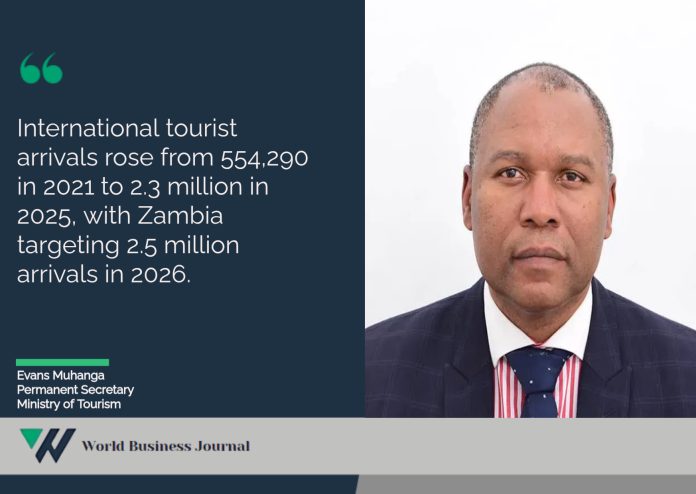
International tourist arrivals rose from 554,290 in 2021 to 2.3 million in 2025, with Zambia targeting 2.5 million arrivals in 2026. The USA is now the leading source market, with 61,586 arrivals, followed by China with 55,008. The United Kingdom, previously Zambia’s largest source market, ranked third in 2025 with 40,290 arrivals.
In Africa, regional markets remain important, particularly Zimbabwe, Tanzania and the Democratic Republic of Congo (DRC). Growth has been driven largely by stronger destination marketing and promotion.
Which government intervention has had the greatest impact in unlocking Zambia’s tourism potential?
A key intervention has been the relaxation of Zambia’s visa regime, with more than 167 countries now eligible for visa-free entry.
The policy has reduced barriers for international travellers, making it easier to book flights, enter Zambia and visit the country with fewer administrative requirements.
How has tourism revenue performed in recent years, and what is driving changes in average spend per visitor?
Tourism contributed about US$700 million in 2025, and the sector is targeting US$1 billion in 2026. Through the development of a Tourism Satellite Account, the government aims to capture tourism’s wider economic impact, including spending on transport, airport services, restaurants, accommodation and other visitor services.
Non-tax revenue collected by the Ministry increased from K131 million in 2021 to K473 million in 2025, while total tourism-related revenue streams grew from K485 million in 2021 to K2.8 billion in 2025.
A key factor has been the digitisation of payment systems through the Government Service Bus and ZamPortal, supported by the Smart Zambia Institute, making it easier for businesses and international visitors to access and pay for government services.
Average visitor stays have also increased from three to four days to around five to seven days, indicating higher visitor spending during trips.
What concrete improvements have been made to tourism access and air connectivity, and what impact are they having on accessibility?
The length of tourism access roads rehabilitated has increased from 1,600 km in 2021 to more than 2,500 km, while loop roads have improved from 556 km to more than 1,270 km.
Working with partners, we have maintained 16 airstrips in protected areas and continued periodic maintenance. We have also upgraded provincial aerodromes, including Kasama and Mansa, while plans are underway for Nakonde Airport, alongside upgrades to Solwezi, Kalumbila and Mfuwe. The private sector has also contributed to runway development and expansion projects, including at Royal Zambezi Airstrip.
Despite these improvements, the infrastructure gap remains significant. Several tourism sites remain difficult to access because of inadequate roads and supporting infrastructure, and we are working with the private sector to address these gaps.
Where is tourism investment currently flowing in Zambia, and which segments are showing the strongest momentum?
Private tourism investment is mainly going into lodges and hotels, particularly around national parks, while MICE is also growing quickly.
A major opportunity is a modern, large-scale conference facility in Livingstone, which could strengthen Zambia’s position as a meetings and conventions destination and attract delegates combining business with leisure.
In Lusaka, demand for hotel rooms increasingly exceeds supply during major conferences and international events, creating opportunities for larger hotels and quality accommodation. The government is also preparing amendments to the Tourism and Hospitality Act, expected to be tabled in the next Parliament after the elections, to bring platforms such as Airbnb into the formal tourism sector through standards and regulation.
What is one of the most significant untapped investment opportunities in Zambia’s tourism sector today?
Kazungula stands out, where Zambia, Botswana, Namibia and Zimbabwe converge around the Zambezi River. The area offers potential for hotels, restaurants and waterfront attractions, while its location at the region’s quadripointgives it a distinctive proposition for tourism investment.
What are the main challenges investors should consider when entering Zambia’s tourism sector, and how is the government addressing them?
The main challenges are transport infrastructure, reliable electricity and development within or near protected areas, particularly in remote tourism locations.
Poor roads can increase construction costs, while Zambia’s 752,614 square kilometres, with about 30% reserved for wildlife, can create challenges involving land encroachment and community engagement.
The government is addressing these through Community-Based Natural Resource Management (CBNRM), ensuring communities participate in and benefit from tourism, while promoting solar and other renewable energy solutions in areas with limited grid access.
How is Zambia leveraging digital tools and technology to enhance its visibility and competitiveness in international markets?
Digital marketing is central to our tourism strategy. Through the Zambia Tourism Agency (ZTA), we worked with Paul Charles to target five priority markets: the UK, Germany, France, Italy and the United States. The campaign surpassed its target of 1 billion online impressions, reaching more than 1.4 billion views.
We also work with Booking.com, Expedia and the BBC, while online visas, digital payments and booking platforms are making travel to Zambia more accessible.
How has domestic tourism performed in terms of volume and its contribution to sector stability?
Domestic tourism grew from 235,000 visitors in 2021 to 562,000 in 2025. The “Take a Holiday Yamu Loko” campaign has encouraged Zambians to explore their own country, with participating lodges offering 20% to 50% discounts.
Why should Zambia be considered a priority tourism destination for international visitors and investors compared with other African markets?
Zambia combines exceptional wildlife, diverse tourism experiences and strong investment potential. Liuwa Plain National Park hosts Africa’s second-largest wildebeest migration, while Kasanka National Park is home to the world’s largest migration of straw-coloured fruit bats, from October to December. The Kavango-Zambezi (KAZA) Transfrontier Conservation Area supports one of Africa’s largest elephant populations, while South Luangwa has Zambia’s highest concentration of hippos and crocodiles.
For investors, Zambia offers a pro-business, private sector-led economy, a liberal foreign-exchange regime and 100% repatriation of net profits, with opportunities across tourism, mining, agriculture and other strategic sectors. The newly launched “Zambia Moves You” campaign brings the country’s tourism and investment opportunities, natural resources and people under one international identity.


