


Uganda Prime Minister Robinah Nabbanja on Where the Next Wave of Investment Will Come From
World Business Journal talks to Rt. Hon. Robinah Nabbanja, Prime Minister of Uganda and Leader of Government Business in Parliament, about turning Uganda’s $500 billion economic ambition into investment, jobs and growth -and the reforms and government coordination needed to deliver it.
Uganda’s Tenfold Growth Strategy targets a $500 billion economy by 2040. Which investment opportunities today have the greatest potential to accelerate progress toward that target?
The major opportunities are in the four core growth sectors of the Tenfold Growth Strategy: ATMS – agro-industrialisation, tourism, minerals, and science and technology.
In agro-industrialisation, we need to boost value addition through agro-processing for export, while meeting global market standards as a core principle. This has already started, with UNBS under the Ministry of Trade and the Food Safety Standards Authority under MAAIF enforcing standards for domestic consumption and exports.
Investment opportunities exist in agro-processing and industrial development. Through programmes such as the Parish Development Model (PDM), we are mobilising people to increase production and productivity, with opportunities for investors to join as nucleus farmers producing for export.
There is also scope for investment in packaging technology, fertiliser production, improved animal breeds, feeds and seeds, as well as expanding and adding value to established crops such as coffee and cocoa. Fruit processing offers opportunities for domestic and international markets, including pineapple, mangoes and oranges.
In tourism, Uganda is one of the best tourism destinations in the world. While we already attract visitors, we need to increase their numbers and length of stay. Opportunities include modern hotels and expanding tourism products such as cultural heritage, faith-based tourism and agro-tourism.
The third is mineral development. We have significant deposits of oil and gas, gold, iron ore, copper, cobalt, phosphate and other minerals, creating opportunities in exploration, extraction and processing. We want, for instance, to export gold at 99.9% purity.
With the East African Crude Oil Pipeline completed, we are seeking investment in the downstream oil and gas sector so we can also export refined products. First oil is expected by December, and we have named the oil “Pearl Sweet”. Further opportunities exist in oil and gas exploration, with only 40% of the Albertine Graben explored.
We also need plants to process phosphate into commercial fertilisers. Our mineral reserves include 300mn tonnes of iron ore, 54.9mn tonnes of vermiculite, 500mn tonnes of limestone and marble, 4.5mn tonnes of copper, 1.7bn tonnes of graphite, 3bn tonnes of aluminous clay rich in rare earth elements, 230mn tonnes of phosphate and 221,125kg of gold.
The fourth ATM is science, technology and innovation. We are using ICT, the creative industries and technological advancement to build a competitive, knowledge-based economy. Opportunities include medical equipment and vaccine manufacturing, vehicle production through Kiira Motors, electronics using our mineral resources, and creative and entertainment facilities
Uganda has long pushed for more value addition and fewer raw material exports. What is still holding back greater investment in production, processing, and manufacturing?
We have established industrial parks in Namanve, Mbale, Buikwe and Kapeeka, with more underway. More than 18 industrial training hubs have also been established under the presidential initiative.
We are also reducing the cost of doing business. Investment in power generation has enabled electricity tariffs for extra-large and large manufacturers to fall from around $0.08 to $0.05 per kWh.
To reduce the cost of finance, Government has capitalised the Uganda Development Bank to provide low-interest loans for production, processing and manufacturing. More patient capital, with affordable terms and longer repayment periods, is also needed to help low-income earners start small and grow their businesses.
Transport costs are also being reduced through rehabilitation of the MGR, expanded tarmac road links, and ongoing construction of the SGR from Malaba to Kampala, linking with Kenya’s network and beyond.
Uganda has been named one of Africa’s best investment destinations, and we continue to improve the investment climate through tax and non-tax incentives. The Uganda Investment Authority serves as a one-stop centre for investors, helping simplify the investment process.
After five years at the center of government, where do you see the biggest gap between policy decisions and results on the ground, and what needs to change in how government operates to close that gap?
The main gap I found when I came into office was coordination in implementation. Since then, government has introduced programme-based budgeting to address it. For example, cold rooms had been built in fishing areas without nearby power. The Ministries of Agriculture, Energy, and Works and Transport now coordinate roads, electricity and production.
This approach has strengthened implementation across government. Over the last five years, we achieved 88% of our 2021–2026 manifesto commitments, with the remaining 12% carried into the 2026–2031 manifesto.
As a leader of government business with a central role in shaping the legislation behind Uganda’s economic agenda, where do you see the biggest legislative gap between Uganda’s economic ambitions and what businesses and investors actually need from government?
Uganda has no shortage of economic strategies. The priority now is legislation that makes them implementable through regulatory coherence, predictable taxation, faster approvals, stronger contract and property rights, and streamlined licensing and dispute resolution.
Parliament’s role is to ensure these laws work together to reduce the cost and barriers to doing business. Some reforms are already partly implemented, with further progress expected this term
As Uganda’s first woman Prime Minister, now serving a second term, what has your first term taught you about leadership, and what will you do differently?
My first term taught me that leadership is not only about setting priorities, but ensuring they are carried through. I began by personally monitoring programmes and projects in the field; today, more Ministers are doing the same. My role has evolved toward stronger coordination and mentoring. Building on that experience, I will work more closely with Ministries, Departments, Agencies and Local Governments to strengthen implementation and keep government focused on results.
International investors form their view of Uganda through what government communicates, what they read, and what they experience on the ground. In your opinion, which part of Uganda’s investment story still needs to be better understood internationally?
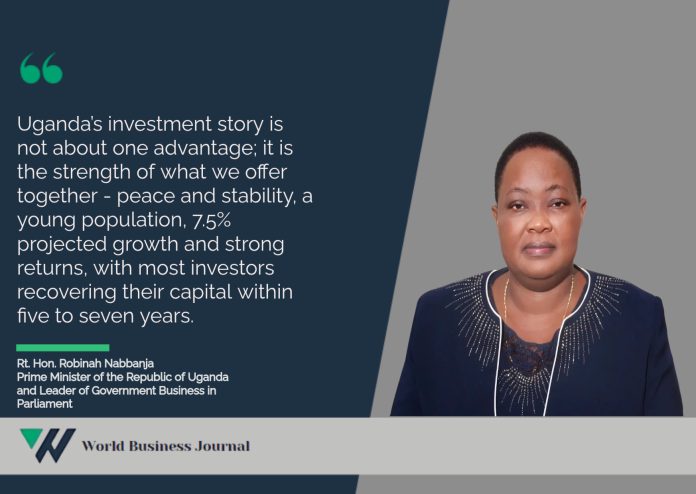
Uganda’s investment story is not about one advantage; it is about the strength of what we offer together – peace and stability, 7.5% projected growth, strong returns with most investors recovering their capital within five to seven years, abundant natural resources, expanding infrastructure and energy, and a young population.
More than 71% of Ugandans are under 35, giving us a young workforce and growing market. We have fertile soils, two rainy seasons, abundant freshwater, and a stable currency. Infrastructure is expanding across road, rail, water and air, while we target 52,000MW of generation capacity by 2040 through hydropower, solar, geothermal, nuclear and wind.
These fundamentals are the foundation of Uganda’s investment proposition and the story we need the world to understand.


