


Rubanga Cooperative’s Approach Drives Higher Coffee Productivity and Profits
World Business Journal talks to Muhangi James, CEO of Rubanga Cooperative Society, about the organisation’s initiatives to empower coffee farmers in exporting their produce, comply with the EU Deforestation Regulation using geolocation data for farmer profiling, and the benefits of adopting climate-smart coffee varieties to improve productivity.
What is the primary objective of the Rubanga Cooperative Society?
Established in 1986, our cooperative empowers smallholder farmers by uniting them to produce high-quality export goods. We have 10,578 members and collaborate with 13 cooperatives, impacting over 23,000 farmers.
We specialise in bulk purchasing, processing, and exporting coffee while providing financial support, affordable inputs, and expert advisory services. Our cooperative is Fairtrade and Rainforest Alliance certified, ensuring that market premiums benefit our farmers. In 2024, we exported 2,100 MT of coffee to Europe, South Africa, and South Korea.
How has the cooperative adapted to the EU Deforestation Regulation?
Working with the Rabo Foundation, we’ve profiled all our farmers with geolocation data and field boundaries to comply with the EU Deforestation Regulation (EUDR). Using the Ex-Meridia platform, we verify each farmer’s compliance with these rules.
This process ensures that our coffee is recognised as originating from Uganda, providing significant benefits for our farmers. It simplifies the traceability of coffee from farm to market, enhancing transparency and marketability.
How are you collaborating with farmers to address the challenges posed by climate change?
Over the past 4 years, we’ve been promoting climate-smart coffee varieties such as the KR1 to KR10 series.
These varieties, developed by the National Agricultural Research Organisation and the National Coffee Research Institute, are drought-tolerant, early-maturing, and coffee wilt disease-resistant.
In partnership with the Agricultural Business Initiative (aBI) Development and the European Union through the MARKUP project, we subsidised cuttings to promote their adoption and provided solar-powered irrigation kits. Funded equally by aBI Development and farmer groups, these kits are used by over 120 groups, reducing carbon emissions and improving efficiency.
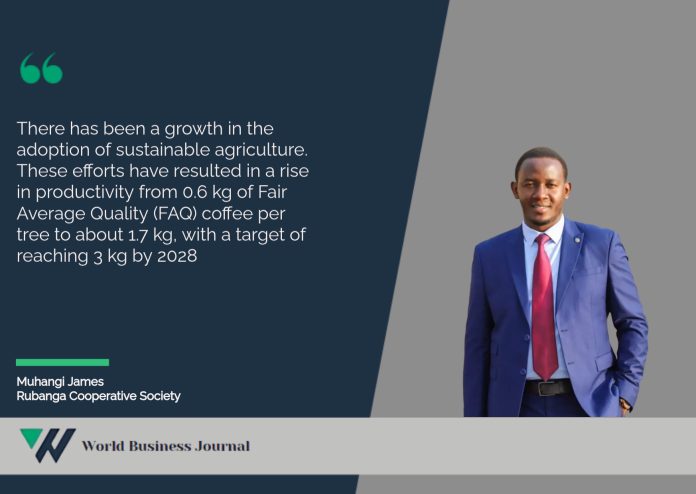
There has been a growth in the adoption of sustainable agriculture, such as mulching, cover cropping, pruning, and coffee garden rehabilitation through stamping, which all contribute to soil conservation and productivity.
These efforts have resulted in a rise in productivity from 0.6 kg of Fair Average Quality (FAQ) coffee per tree to about 1.7 kg, with a target of reaching 3 kg by 2028. Through these climate-smart interventions, we’re seeing substantial improvements in farmers’ resilience to climate variability, alongside enhanced productivity.


