


A Stronger Private Sector Voice in Zambia: How the PPDF Is Changing Policy Engagement
World Business Journal talks to Jacqueline Saidi Chishimba, Deputy Director General of the Public-Private Dialogue Forum (PPDF), about how structured public-private dialogue is giving businesses a direct voice in Zambia’s economic reform agenda, turning private sector concerns into policy discussions and helping shape a more predictable environment for investment and growth.
The PPDF was established to ensure the private sector has a direct voice in shaping economic policy. Looking back over the past four years, can you point to one policy that would not have changed without the Forum’s intervention?
One example is our role in advancing reforms in mining and energy, two sectors where private sector participation has been critical.
In mining, we raised concerns that Zambian-owned firms were largely shut out of the mining value chain, with only 2.5% of mining inputs being sourced from Zambian companies. This engagement contributed to the adoption of the Geological and Minerals Development (Local Content) (Preference for Goods and Services in the Mining Sector) Regulations under Statutory Instrument No. 68 of 2025 in October 2025. The regulations introduced a progressive reservation scheme for mining procurement, beginning with a 20 percent allocation for local companies in 2026 and rising to not less than 40 percent within five years, with a 15 percent price preference for local firms in bid evaluation.
In energy, we engaged on reforms to address a sector dominated by ZESCO as a vertically integrated state utility, purchasing as much as 80% of the electricity consumed under power purchase agreements. Through the Open Access Regulations, anchored in the Electricity Act of 2019, Independent Power Producers can now generate and sell electricity directly to eligible consumers, moving away from the single off-taker model.
We have remained engaged throughout implementation, including the December 2023 roundtable with the Ministry of Energy and the Energy Regulation Board, and the March 2026 discussions with the Ministry of Energy, ERB, the Office for Promoting Private Power Investment, and ZESCO to validate the Market Process Maps for the Open Access market. These examples show how structured dialogue has allowed private sector concerns to be identified, addressed and converted into policy reforms.
The private sector is often described as the engine of economic growth, yet many SMEs still struggle with access to finance, regulation and market access. How is the PPDF ensuring that its agenda reflects the needs of smaller businesses and not only large corporate players?
Our agenda is driven by sector priorities rather than the size of the business. Through the Technical Working Group structure, SME-dominated sectors such as tourism, agriculture and ICT have dedicated platforms for engagement, alongside larger sectors like mining. This is reflected in our reform agenda, which includes 30 reforms in agriculture, 19 in tourism and 16 in ICT, demonstrating that the concerns of smaller businesses are equally represented in our policy dialogue.
How does the Forum work with international partners such as the IFC?
Our partnership with the IFC is built on a formal foundation. The PPDF concept began with an IFC-supported project in 2021, which later informed our district-level rollout. This was formalised through a Memorandum of Understanding signed with the IFC on 18 July 2022 to strengthen structured public-private dialogue. The IFC committed US$500,000 over eighteen months to support the Forum, while Government provided the secretariat offices and operational tools, and has since assumed full responsibility for funding operations.
If there’s one misconception about Zambia’s business environment that you would like the private sector, both locally and internationally, to stop believing, what would it be?
This is the foundation on which growth is now being built. With greater economic stability, Zambia is positioned for expansion, with GDP growth projected at 5.5–5.8 percent in 2026, driven by mining recovery, record agricultural output and improved electricity generation. The principle is simple: you cannot build lasting growth on unstable foundations. Stabilisation created the confidence needed to attract investment, expand production and open more opportunities for businesses and citizens. This supports Government’s ambition to double the economy post-2026 through provincial decentralisation and continued investment.
What’s the biggest lesson the PPDF has learnt from bringing Government and business to the same table that policymakers didn’t fully appreciate before?
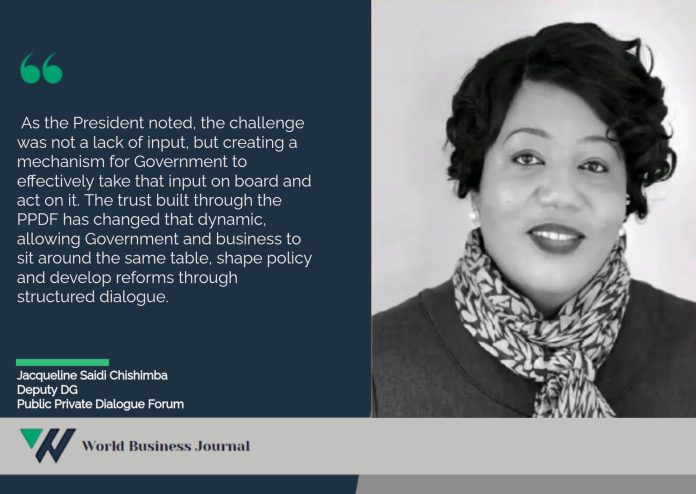
The biggest lesson is that the private sector was never short of ideas or solutions. As the President noted, the challenge was not a lack of input, but creating a mechanism for Government to effectively take that input on board and act on it. The trust built through the PPDF has changed that dynamic, allowing Government and business to sit around the same table, shape policy and develop reforms through structured dialogue.
Looking back at the journey of the PPDF, what is the biggest change you have seen in the way Government and the private sector engage, and how will that new relationship shape Zambia’s economic future?
The biggest change has been a shift in mindset. At the launch of the PPDF in 2022, the President emphasised that development could not be left to Government alone, and that principle is now reflected in how Government and the private sector engage.
The impact of this partnership is reflected in the numbers, with 168 reforms implemented and our Private Sector Day attracting over 1,500 delegates from Government, the private sector, cooperating partners and civil society. Looking ahead to our 2027–2032 outlook, the 2026 theme, Driving Jobs and Shared Prosperity, captures the direction of this partnership: building a private sector-led approach to economic growth.


