


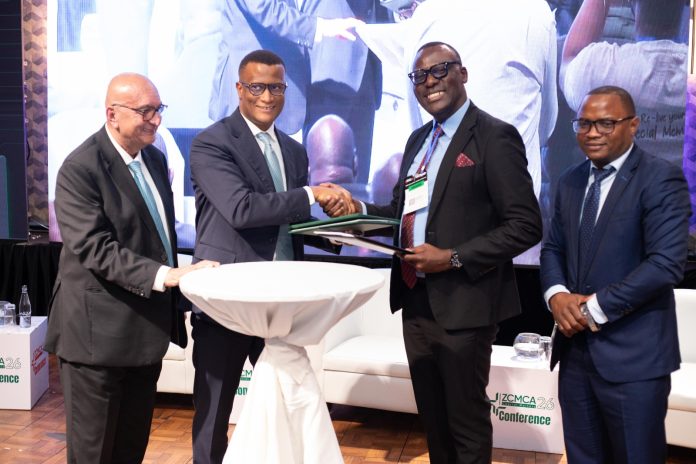
LuSE Signs Africoin and AFRINEX MoUs to Advance Tokenisation and Regional Capital Access
The Lusaka Securities Exchange (LuSE) is advancing its capital-market development on two fronts, with new partnerships focused on tokenisation and blockchain-based infrastructure, alongside stronger regional market connectivity.
A Memorandum of Understanding signed with Africoin on 1 October 2026 in Livingstone focuses on applying tokenisation and blockchain technology to capital markets, opening a new avenue for the exchange as it looks at how digital infrastructure can support the evolution of securities markets.
At the same time, an agreement with AFRINEX strengthens LuSE’s links with the wider African capital-market network, creating potential channels for connecting Zambian issuers and investors with regional capital and liquidity while increasing the visibility of investment opportunities listed in Lusaka.
Both agreements were signed during the Zambia Capital Markets Conference and Awards (ZCMCA) 2026, held from 30 September to 2 October at the Avani Victoria Falls Resort. Hosted by LuSE, the conference brought together policymakers, regulators, investors, financial institutions and market participants to discuss the development of Zambia’s capital markets.
Tokenisation and the future of capital markets
Tokenisation creates a digital representation of an asset or financial instrument using distributed-ledger technology. Within regulated markets, it can change how securities are issued, transferred and settled, while supporting new approaches to ownership, investment and market infrastructure.
Tokenisation was also a dedicated theme at ZCMCA 2026. A panel titled “Will Tokenisation Transform African Capital Markets by 2030?” included Reginald Tumusiime, linking the conference discussion directly to the partnership with Africoin.
International financial markets are already examining how tokenisation can operate alongside established infrastructure. In September 2026, the European Central Bank launched Pontes, enabling wholesale transactions involving tokenised assets to settle in central bank money. The ECB said the system is part of its broader strategy for integrating tokenised finance into the financial system.
The Bank of England’s Project Meridian Securities has similarly tested how tokenised securities can be settled against central bank money, including delivery-versus-payment transactions and programmable liquidity-management applications.
For Zambia, the practical value of the LuSE–Africoin partnership will depend on how tokenisation can be integrated into regulated market infrastructure, including investor protection, custody, cybersecurity, settlement, liquidity and interoperability with existing systems.
Africa moves towards digital market infrastructure
African markets are also examining applications for tokenised assets. South Africa’s Project Khokha 2, led by the South African Reserve Bank, explored the use of distributed-ledger technology for tokenised securities and wholesale central-bank money, including implications for securities trading and settlement.
These developments point to a wider evolution in financial-market infrastructure, with exchanges and financial institutions assessing how distributed-ledger technology can support securities issuance, ownership and settlement within established regulatory frameworks.
The LuSE–Africoin partnership therefore places tokenisation within a broader capital-market discussion: not simply whether securities can be represented digitally, but how digital infrastructure could interact with the systems governing issuance, trading, settlement and investor participation.
Regional capital-market connectivity
The AFRINEX agreement addresses another part of that market-development equation: access and connectivity.
AFRINEX is a Mauritius-based, multi-currency and multi-asset exchange offering platforms for listing, trading and capital raising across asset classes, alongside clearing and depository services. Its recent partnerships have focused on extending cross-border market access. In August 2026, AFRINEX and the Rwanda Stock Exchange signed an MoU covering cross-border investment and capital-market integration. Earlier this year, AFRINEX and India INX agreed to cooperate on areas including dual listings, investor reach and joint product development.
For LuSE, stronger links with AFRINEX could connect Zambian issuers and investors to a broader pool of regional capital and liquidity. For companies seeking investment, wider market access can expand the potential investor base; for investors, stronger exchange links can provide additional routes into opportunities across African markets.
The partnership can also increase the visibility of Lusaka-listed companies and investment opportunities within a wider regional market. Over time, stronger connectivity could support greater participation by investors looking for long-term exposure across African capital markets.
Building the market from both sides
The two partnerships address complementary challenges facing modern capital markets: how markets can evolve their infrastructure and how effectively they can connect issuers and investors to capital beyond their domestic base.
Africoin brings the tokenisation and blockchain dimension, while AFRINEX brings a regional connectivity and capital-access dimension. Together, the agreements give LuSE two avenues for developing its market – combining technological evolution with stronger links to the African investment landscape.


