


Zahra Foods Uses Jackfruit Innovation to Expand Plant-Based Product Portfolio
World Business Journal talks to Quresh Fidahusein, Founder & CEO, Zahra Foods, about his company’s innovative plant-based product line, the demand for ready-to-eat options, the company’s competitive advantage in dehydrated products, and integration of refugees into commercial activities through the ‘Travel Beyond Bars’ project.
Could you give us a brief overview of your company?
Founded in 2008, “Zahra” means “blossom” in Arabic, symbolising our focus on growth and vitality. Our product line features dehydrated Ugandan tropical fruits like pineapples, mangoes, and bananas, along with various nuts. We export 70% of our products internationally, while 30% are sold locally.
In 2021, through the Dutch Embassy’s acceleration programme, we developed a plant-based meat product using dehydrated jackfruit. Our product rehydrates to 7 times its weight, lowering shipping volumes and environmental impact.
In Uganda, where commercial jackfruit farming is absent, our value chain transforms subsistence farming into an economic opportunity. We now partner with 300 farmers, having harvested around 210 tonnes in 2024.
What is the market potential for the jackfruit-based product?
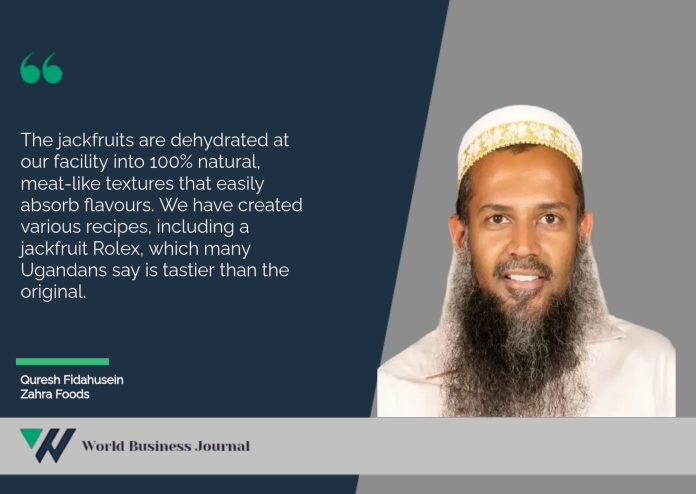
We’re focusing on the rapidly growing plant-based market in Europe and the West, largely driven by health-conscious consumers adopting vegetarian or vegan lifestyles. The jackfruits are hand-selected at a young age from ancestral trees across the country and dehydrated at our facility into 100% natural, meat-like textures that easily absorb flavours.
We are also developing B2C products targeting the demand for ready-to-eat options. We have created various recipes, including a jackfruit Rolex, which many Ugandans say is tastier than the original.
Experimenting with recipes is crucial due to the unfamiliarity with this new ingredient. Our strategy relies on demonstrating its use to potential buyers who often lack knowledge about it.
What are the main goals and impacts of the “Travel Beyond Bars” project, developed in collaboration with the Japan International Cooperation Agency?
The project seeks to improve the integration of refugees into commercial activities through private sector involvement.
We collaborate with the Kyangwali Refugee Settlement, located on the shores of Lake Albert, to source 50% of the ingredients for The Blossomz Revive Breakfast Bars. These bars are already available in the U.S. market and in supermarkets in Kampala.
Having successfully demonstrated this proof of concept, the project is now seeking funding to scale up.


