


UNOC CEO Proscovia Nabbanja Details Upstream Growth Strategy and New Crude Blend Plans
World Business Journal talks to Proscovia Nabbanja, CEO of the Uganda National Oil Company, about the company’s growth trajectory as the oil and gas sector advances, the progress achieved in developing the Kasuruban block, and the efforts to build marketing and trading capabilities while progressing toward launching a new crude blend in the market.
How have the latest advancements in the upstream sector developed the operational knowledge of the Uganda National Oil Company (UNOC)?
Our role as a commercial entity and Joint Venture Partner (JVP) has required us to negotiate and execute complex commercial frameworks for various projects across the entire petroleum value chain, which has deepened our understanding of value extraction, risk allocation, cost recovery, and commercial structuring in large-scale petroleum projects.
We have also gained substantial institutional knowledge in project design and execution, which has enhanced our technical understanding and refined our project delivery competencies.
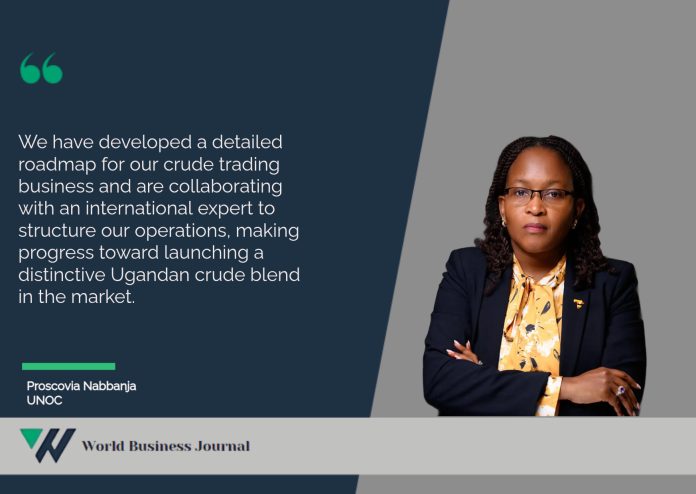
We are proactively building our crude marketing and trading capabilities and have developed a detailed roadmap for our crude trading business. We are currently working with an international expert to structure the operation and are progressing toward the launch of a distinctive Ugandan crude blend in the market.
The award of the Kasuruban Contract Area marked a significant milestone in our journey toward becoming a fully-fledged upstream operator, capable of independently acquiring and developing exploration acreage.
What progress has been achieved in the development of the Kasuruban block, and what is the current status of securing a joint venture partner for future operations?
We have embarked on a work programme including seismic data reprocessing and an ongoing Environmental and Social Impact Assessment (ESIA). Parallel to our technical activities, we are actively pursuing a joint venture partner as required under the licence that was issued. We are in the process of identifying a partner with the right blend of technical capability, financial strength, and shared commitment to national value creation.
Looking ahead, we plan to progress to the acquisition of 3D seismic data and undertake key engineering studies in partnership with the selected JV partner. These efforts are expected to culminate in the submission of Field Development Plans to the Petroleum Authority of Uganda by the end of 2025.
In 2024, UNOC became the sole importer of petroleum products. What impacts have been observed on supply chain security and pricing since this change?
Direct sourcing and importation of petroleum products have provided our country with end-to-end supply chain visibility, enabling timely interventions with stakeholders to ensure supply continuity and security.
The direct transactions with the Ugandan OMCs have also eliminated unnecessary layers of intermediary transactions and the associated speculation
Giving a uniform price per product type and vessel delivery to all OMCs has boosted competition for market share, leading to better consumer and retail prices.


