


MoICT Permanent Secretary Aminah Zawedde Highlights Untapped BPO Opportunities, Device Tax Reforms, and Digital Transformation
World Business Journal talks to Aminah Zawedde, Permanent Secretary at the Ministry of ICT & National Guidance, about the five-year digital transformation roadmap, emphasising Uganda’s potential as a BPO hub in Africa and outlining initiatives to improve digital infrastructure, internet penetration, and the introduction of tax reforms to lower smart device costs.
What are the top priorities of the five-year digital transformation roadmap?
We are focusing on five key pillars identified through an ICT sector assessment. While we excel in the enabling environment at about 70%, other components—digital infrastructure, digital services, digital skills, innovation, research, and cybersecurity—are below 50%. Our roadmap prioritises improvements in these areas over the next five years.
We are expanding our digital infrastructure by rolling out internet access, increasing the number of data centres, and establishing computer labs in schools to ensure widespread availability of devices. We aim to transition as many services online as possible to increase accessibility and income generation.
As we move services online, ensuring secure transactions and protecting sensitive data is crucial to building public trust in digital services. We are improving digital literacy and skills through curriculum reforms in collaboration with the Ministry of Education and Sports, covering basic to advanced skills in areas like AI and cloud computing.
Fostering innovation is essential for economic development. Supporting young entrepreneurs to create homegrown solutions can address local challenges and potentially serve broader markets.
To boost job creation, we are promoting business process outsourcing and have established innovation hubs, including the National ICT Innovation Hub in Nakawa, which has incubated over 70 innovators. Notable projects include the Online Business Registration System (OBRS) and the Parish Development Management Information System (PDMIS), both of which were developed by Ugandan innovators to enhance data management and improve service delivery.
What specific objectives have been set to reduce internet costs and increase internet penetration?
Internet penetration is crucial for digital transformation in Uganda. We are implementing a National Backbone Infrastructure (NBI) project, with over $200M in funding from the World Bank under the Uganda Digital Acceleration Project (UDAP) and Exim Bank for Phase 5 of the NBI. This phase aims to expand national connectivity from 50% to 70% by 2026–2027.
To lower setup costs, we are leveraging private sector interest and promoting infrastructure sharing, which allows providers to utilise existing government infrastructure and reduce redundancy.
In collaboration with MTN, JICA, and UNDP, we aim to increase smartphone access, though demand currently exceeds supply. High maintenance costs lead to higher user prices, impacting citizens, especially with 70% of Uganda’s population under 30 and an average of 5 children per family.
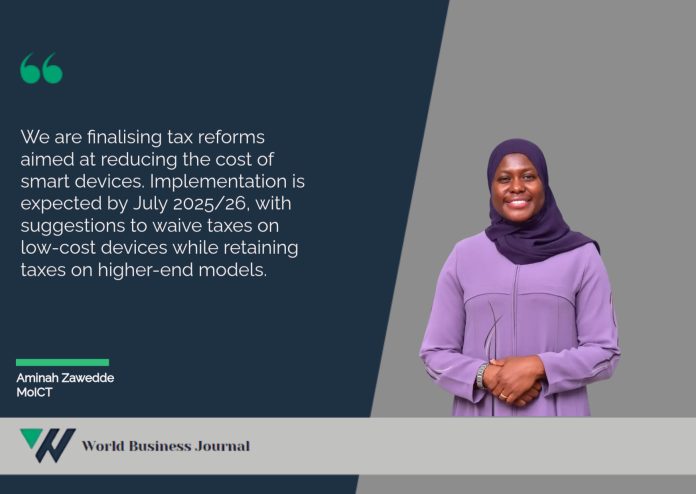
We are finalising tax reforms aimed at reducing smart device costs, which are crucial for improving internet access. Implementation is expected by July 2025/26, with suggestions to waive taxes on low-cost devices while retaining taxes on higher-end models.
What potential does the Business Process Outsourcing (BPO) sector hold?
The BPO sector has significant growth potential, energised by strategic government incentives, including tax benefits for large employers and reduced internet costs.
The ideal time zone (GMT+3) allows for 24/7 service to international clients, and with around 30,000 graduates annually in relevant fields, there’s a robust talent pool available. Partnerships with companies like Helpware, which expanded from 50 to 500 employees in just two years, underscore the sector’s scalability and attractiveness to investors.


