


Nicholas Kabaso on Market Reform, New Listings and Zambia’s Frontier Market Ambitions
World Business Journal talks to Nicholas Kabaso, Chief Executive Officer of the Lusaka Securities Exchange (LuSE), about Zambia’s evolving capital markets and their role in investment and business financing. With four listed companies valued above $1 billion and the first SME and technology listing on the Alternative Market in 11 years, the discussion examines market reforms, broader access to capital and the drive towards frontier-market status.
What impact are the market modernisation reforms having on efficiency and investor participation?
As investor interest grows, we need a steady pipeline of issuers and products. We are improving efficiency while attracting new issuers to deepen the market.
Product diversity has expanded with Zambia’s first Real Estate Investment Trust (REIT), enabled by recently enacted rules. It was also our first dual-currency listing, introducing dollar-denominated trading alongside local-currency listings and demonstrating our capacity for multi-currency trading.
Investor demand has driven higher turnover and valuations.
In the past year, four companies crossed the $1 billion market-capitalisation mark: Copperbelt Energy Corporation (CEC), ZCCM Investments Holdings (ZCCM-IH), Zambia Sugar and Airtel.
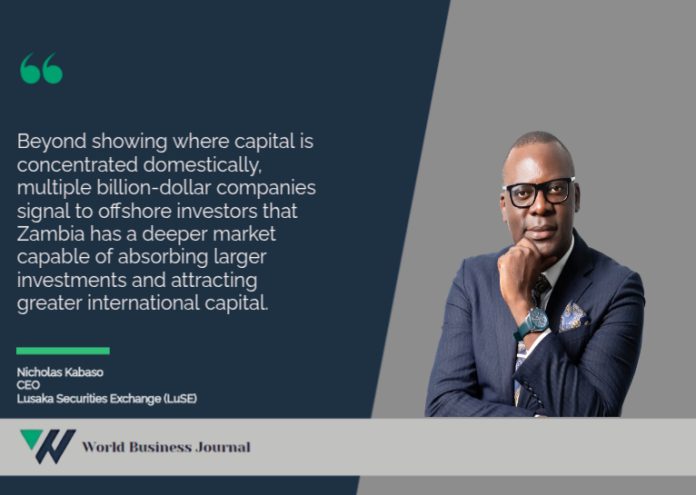
Beyond showing where capital is concentrated domestically, multiple billion-dollar companies signal to offshore investors that Zambia has a deeper market capable of absorbing larger investments and attracting greater international capital.
Zambia has outlined a 24-hour economy. Do you see a 24-hour trading window becoming possible soon, and what challenges remain?
Enabling full 24-hour trading requires the right infrastructure and a regulatory framework to support it. We have started reviewing our framework and expect to have draft rules addressing 24-hour trading by the end of this year.
Trading hours have already been extended by one hour, with plans to add two more hours this year.
Beyond regulation, the main challenge is domestic demand. International players may not necessarily need to trade around the clock, while locally the question is whether there is sufficient critical mass to sustain 24-hour operations and whether the cost of the required infrastructure can be justified by the revenues generated.
We aim to have the infrastructure in place within two years, subject to regulatory changes.
How is the LuSE revising its listing framework to widen access while maintaining investor protection?
We’re overhauling the entire rulebook under Zambia’s 10-year capital market master plan, which identified regulatory reform as a key gap. The aim is to simplify requirements while maintaining investor and issuer protection.
The current rules make it difficult for startups and young businesses, even those just two years old, to access market funding. We’re lowering barriers to entry and exit to enable more patient, scalable capital for SMEs, while providing safeguards for businesses with less formal governance structures.
Our rulebook was benchmarked against the Johannesburg Stock Exchange (JSE) in 2008 and has not been substantially updated since. The JSE has since simplified its framework, and alignment could support harmonisation with Nairobi, Zimbabwe, Namibia and Botswana if regional harmonisation moves forward. The aim is greater agility and innovation.
How is the Alternative Market (Alt-M) performing, and what needs to happen for it to scale?
The alternative market is gaining momentum, driven by SME demand.
It took about 11 years after its establishment to see significant appetite, with Dot Com Zambia PLC becoming the first technology company and SME to list on the Lusaka Securities Exchange (LuSE) Alternative Market (Alt-M) in late 2025.
We are currently working on two Alt-M listings, with One Square K Property Development Plc next to list and three more in the pipeline.
The main challenge remains the cost of funding. A standard bond can require net profit margins above 25%,which is onerous for smaller businesses. Growing retail investor demand is helping SMEs access cheaper, longer-term capital.
Fiscal incentives, such as tax rebates for growth businesses raising capital on Alt-M, could further encourage SME listings.
What more is needed to deepen market liquidity and attract greater institutional and international participation?
We need a deliberate policy framework. Our main statutory pension fund receives upwards of $10 million monthly but manages investments in-house through a small team with conservative limits. We propose outsourcing part of these portfolios to external fund managers and reviewing allocation limits, some unchanged for a decade.
Private pensions face a similar constraint. Unlike the US 401(k) system, contributions cannot currently transfer between employers’ schemes. Allowing transfers, potentially with a 15-year vesting period, would encourage longer-term investment, while bringing the informal sector into pension schemes would expand the investment pool.
Development agencies could also link part of large investments to public-market participation – for example, 5% or 10% – giving ordinary Zambians a stake without diluting investor control. Mining is a clear example.
The recent review of the Securities Act and our capital market master plan support this direction, including the goal of achieving frontier-market status under indices such as.MSCI. Zambia has listed companies valued above $1 billion and is working to meet the remaining criteria. Frontier status would raise Zambia’s international visibility and could attract further capital.


