


W.K Mutale Nalumango, Zambia Vice President, on the UPND’s First Term, Zambia’s Economic Direction and What Is at Stake in the Election
World Business Journal talks to Mrs. W.K Mutale Nalumango, Her Honour the Vice President of the Republic of Zambia, in an exclusive interview as the UPND approaches the next election and Zambians prepare to assess its first term in office. In this conversation, Vice President Nalumango discusses the government’s economic and social agenda, the policies that have shaped its tenure, progress made, challenges that remain, and the argument the UPND is presenting for another term as Zambians make their choice on 13 August.
The Free Education Policy has significantly increased enrolment. What evidence do you have that learning outcomes are improving at the same pace, and how is government addressing the strain on classrooms, teachers, and infrastructure?
The results are already evident. More than 2.3 million learners have returned to school. Learning outcomes are also improving. The Grade 12 pass rate increased from 67.1% in 2021 to 70.3% in 2025, while the Grade 9 pass rate rose from 53.6% in 2023 to 72.3% in 2025. These are clear indicators that access and quality are improving together.
We recruited 30,496 teachers in 2022 alone, and a total of 41,917 teachers so far, with a further 3,500 planned for recruitment in 2026.
School feeding, water and sanitation programmes are expanding. Higher education is being supported through loans and bursaries, while the revised curriculum places greater emphasis on practical skills, problem-solving, science, technology, and innovation. Importantly, free education is now protected by law through the Education (Amendment) Act No. 17 of 2026.
I know what it means to have potential but lack opportunity. I come from a rural village and was raised as an orphan in poverty.
Had free education not existed, I would not be sitting here today.
How can I forget the child I once was and deny another child the same chance that transformed my life? Every Zambian child, whether orphaned, disadvantaged, or born in a remote village, deserves the same opportunity that changed my life.
For this government, free education is not an expenditure; it is an investment in Zambia’s future. Our legacy will be a generation that is educated, empowered, and ready to build the nation.
How would you assess Zambia’s current economic direction in terms of investment stability, and what impact have reforms in mining tax policy, agricultural support, and energy sector participation had on investor sentiment and capital inflows?
We have implemented reforms across mining, agriculture, and other sectors to drive investment and growth.
In agriculture, we have created a predictable policy environment that has encouraged farmers to return and invest. Agricultural equipment is supported through incentives such as import tax waivers and reductions, while irrigation equipment is zero-rated to promote mechanisation and climate-smart farming.
As Zambia moves beyond reliance on rainfall, we are expanding irrigation, solar-powered systems, and year-round production across key crops. Maize production is rising towards the President’s 10 million metric tonnes target, with projections of over 5 million metric tonnes this year, alongside targets of 3 million metric tonnes of soya and 1 million metric tonnes of wheat.
When we came into office, many mining disputes were ending up in court. Through the Public Private Dialogue Forum (PPDF), we have promoted mediation and dialogue. These reforms have created a stable environment where both local and international investors feel protected and confident to grow.
Mines that were closing have reopened, while others are expanding. Mopani has reopened, KCM is operating again after disputes were resolved through arbitration, and FQM is expanding. At Shaft No. 28 in Luanshya, the dewatering process is ahead of schedule, and we are preparing to resume actual mining operations. A project in North-Western Province that had stalled for several years is also now operational.
We have introduced regulatory reforms, including the Minerals Regulation Commission, to strengthen governance, improve safety, and bring greater order to the sector as mineral discoveries and gold mining activities expand.
Industrialisation has also expanded, supported by energy reforms that are diversifying Zambia’s power mix beyond hydropower through solar, wind, thermal, and hydro sources. Tourism is also growing, with international arrivals reaching about 2.3 million in 2025 as investment in the hospitality sector expands.
Zambia has recorded economic progress and improved macroeconomic stability under President Hichilema. The government has also created a stable and predictable policy environment that supports investment and long-term growth.
As Zambia’s second female Vice President, and with women still holding only around 15–18% of parliamentary seats, how far has the UPND government delivered on its gender equality commitments in moving women from representation into real decision-making power?
As a woman, I cannot say I am fully satisfied, but I am proud of the progress that has been made. My appointment as the second female Vice President reflects that progress. One area that stands out is the judiciary, where women now outnumber men in many positions.
Through the Constitution Amendment Act No. 13 of 2025, at least 20 women will enter Parliament through reserved seats under proportional representation, addressing the long-standing underrepresentation of women.
Challenges remain. Cultural stereotypes and economic barriers continue to limit women’s participation and access to political support. However, the President has prioritised gender-balanced appointments across government, while more women are also rising into leadership positions in the private sector.
I was proud to become the first woman to preside over Parliament as Deputy Speaker, and today Zambia has its first female Speaker of the National Assembly. These milestones show progress, but the responsibility now falls on women who have attained positions of influence to open doors for other women.
I often hear the saying that “women do not support women,” and I dislike that narrative. In fact, women do support women, and we should say it loudly. Too often, that negative narrative benefits others by keeping women divided.
Zambia has experienced repeated droughts and climate shocks during your tenure. What specific improvements have been made in early warning systems and national disaster response coordination since you assumed office?
Today, our focus has shifted from disaster management to Disaster Risk Reduction (DRR). Rather than waiting for disasters to occur, we prioritise preparedness through stronger early warning systems, improved infrastructure, and better communication.
Every district in Zambia now has a weather station, supported by more than 250 automatic weather stations and 1,000 rainfall monitoring points nationwide.
We have also integrated anticipatory action into our planning. Early warning information allows us to pre-position food supplies in areas likely to be affected by drought or extreme heat, particularly those that may become inaccessible.
We are strengthening agricultural resilience by promoting seed varieties suited to different climatic conditions to safeguard food security. The disaster management structure has also been extended to the ward level, with coordination structures now in place at every level.
Through these investments, as the Head of the Disaster Management and Mitigation Unit (DMMU), I am proud to state that during the 2023 drought season, no lives were lost. This achievement reflects the effectiveness of our preparedness and the collective efforts of all stakeholders who worked tirelessly to protect vulnerable communities.
As you reflect on your tenure as Vice President, what would you highlight as the most significant achievements in strengthening Zambia’s governance, investment climate, and overall development trajectory?
One area I value is the National Food and Nutrition Security Policy, which repositioned nutrition from being viewed solely as a Ministry of Health issue to becoming a national development priority. Nutrition is central to health, education, productivity, and economic growth.
I also welcome the transformation of resettlement from a department into a division. The focus is no longer only on relocating people, but on creating safer, more resilient, and productive communities.
At the national level, debt restructuring stands out as a major achievement. Under President Hichilema’s leadership, Zambia restructured more than US$13 billion in external debt, strengthened macroeconomic stability, supported kwacha stabilisation, eased inflation pressures, and protected key social programmes.
The increase of the Constituency Development Fund from K1.6 million to K40.8 million per constituency has also expanded community-level investment.
The next task is ensuring that stability translates into jobs, higher incomes, and better opportunities. Above all, we have preserved peace , the foundation on which development, investment, and a better future for Zambia are built.
What are your expectations for the United Party for National Development (UPND), currently in office, in securing another mandate from voters in the upcoming election?
We are very confident that Zambians will give the UPND another mandate because we believe people can see the progress and the direction the country is taking.
If this government is growing the economy, why would we change course? We inherited an economy that was contracting by -2% and have moved towards projected growth of 6.5% despite global challenges.
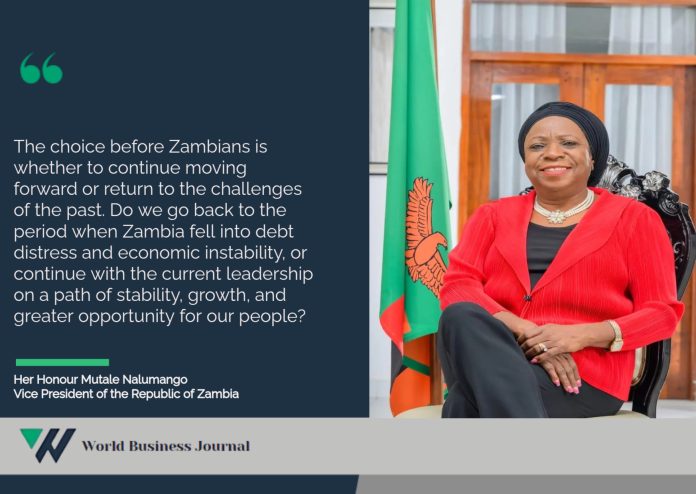
The choice before Zambians is whether to continue moving forward or return to the challenges of the past. Do we go back to the period when Zambia fell into debt distress and economic instability, or continue with the current leadership on a path of stability, growth, and greater opportunity for our people?
But we also understand that people do not experience the economy through statistics alone. They experience it through whether their children can go to school, whether families can access support, whether communities are receiving development, and whether opportunities are increasing.
Some changes are already being felt in communities through free education, expanded social protection, increased community funding, improved services, and greater investment. At the same time, we acknowledge that many families are still feeling the pressure of the cost of living.
That is why we must remain focused and patient. The recovery of an economy takes time, and stability must be converted into better incomes, more jobs, and improved opportunities for citizens.
President Hichilema has shown the importance of steady leadership and a clear vision for Zambia’s future. We know the journey is not finished, but the progress we are making must be protected.
With patience and commitment, we can build a Zambia where stability becomes opportunity and where economic growth creates meaningful benefits for citizens across the country.


