


Exclusive Preview: Zambia’s Economic Turning Point – Vice President Nalumango on Reform, Recovery, and the Election Ahead
World Business Journal sat down with Her Honour Vice President W.K. Mutale Nalumango at her office in Lusaka last month for an exclusive discussion on Zambia’s development agenda, economic reforms, and the country’s future direction as the nation prepares for the 13 August 2026 general election.
The interview comes at a defining moment for Zambia, as the UPND government approaches the end of its first term and voters prepare to assess the impact of its key policies, including debt restructuring, free education, increased community funding, and efforts to strengthen investment. The discussion goes beyond policy announcements to examine what the data shows, what has changed, and whether these measures are translating into greater opportunities and improved living standards for Zambians.
When the UPND administration assumed office in August 2021, Zambia was emerging from the COVID-19 pandemic, facing severe fiscal pressures, high debt distress, and the consequences of becoming the first African nation to default on its sovereign debt. Since then, the country has undertaken a major external debt restructuring process involving more than US$13 billion in debt, a process the IMF has identified as critical to restoring debt sustainability, rebuilding fiscal space, and supporting economic recovery.
The government has also pursued measures aimed at strengthening the investment environment and supporting key sectors, including mining, energy, agriculture, and tourism, while expanding resources for community development. The Constituency Development Fund (CDF) increased from K1.6 million per constituency in 2021 to K40.8 million in 2026 — a more than 25-fold increase — providing greater funding for local development priorities and community-level projects.
Among the key themes explored in the interview is education. Zambia’s Free Education Policy was introduced in 2022, opening access to public schooling by removing tuition fees. This year, the policy was strengthened through the Education (Amendment) Act, 2026, which was signed into law by President Hakainde Hichilema, providing a legal framework for free education.
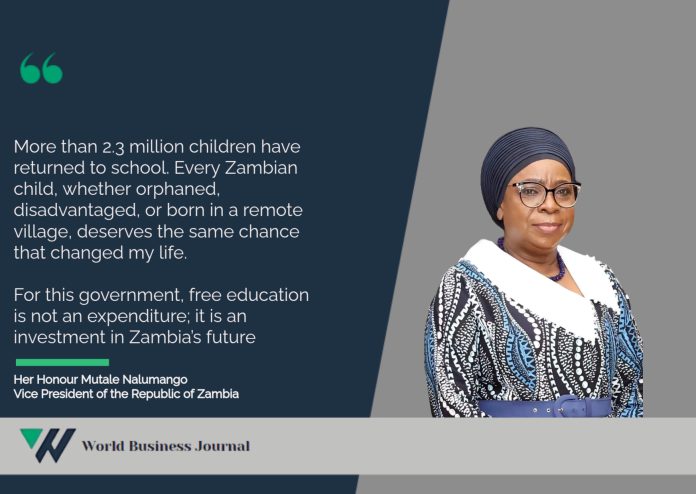
Since its introduction, more than 2.3 million learners have returned to school, supported by the recruitment of more than 41,900 teachers and continued efforts to strengthen education delivery.
The policy has also generated debate, with critics questioning whether expanded access has been matched by improvements in classroom capacity, infrastructure, and learning conditions. Vice President Nalumango acknowledged that education systems must continue to improve, but challenged the idea that children should wait for a perfect system before being given an opportunity to learn.
For her, the debate goes beyond infrastructure and statistics , it is about whether opportunity reaches those who need it most.
Reflecting on her own journey, the Vice President said:
“I know what it means to have potential but lack opportunity. I come from a rural village and was raised as an orphan in poverty. Had free education not existed, I would not be sitting here today.”
She posed a fundamental question: for those with resources, the discussion may be about accessing the best education system. But for disadvantaged families, the question is more basic: can my child even go to school?
“Our responsibility as government is to open that door. What the child does with that opportunity will depend on their effort, commitment, and ambition,” she said.
The interview also examines Zambia’s broader economic direction, including mining reforms, agricultural investment, energy diversification, governance, gender representation, and climate resilience. Vice President Nalumango acknowledges that while progress has been made, many citizens are still waiting to experience the full benefits of economic recovery, particularly amid continued cost-of-living pressures.
She notes that economic performance cannot only be measured through national indicators, but also through the daily experiences of citizens.
“We also understand that people do not measure the economy through statistics alone. They measure it through whether their children can go to school, whether families can access support, whether communities are seeing development, and whether economic progress is being felt in households.”
Some changes are already being felt in communities through free education, expanded social protection, increased community funding, improved services, and greater investment. At the same time, we acknowledge that many families are still feeling the pressure of the cost of living. That is why we must remain focused and patient — the recovery of an economy takes time, and stability must be turned into better incomes, more jobs, and improved livelihoods.”
As the election approaches, Vice President Nalumango says she is confident the UPND will secure another mandate, arguing that voters must decide whether to return to past challenges or continue building on the progress achieved under the current leadership.
“The choice before Zambians is whether to go back or continue moving forward. Do we return to the opposition under whose leadership Zambia fell into debt distress and economic instability, or continue with the current leadership on a path of stability, growth, and greater opportunity for our people?”
She adds that President Hakainde Hichilema has demonstrated the importance of steady leadership and a clear vision for Zambia’s future, while recognising that the journey is not complete and that stability must continue to translate into jobs, higher incomes, and improved livelihoods for citizens.
The full exclusive interview with Her Honour Vice President W.K. Mutale Nalumango, covering Zambia’s economic reforms, investment climate, education, governance, and development agenda, will be published soon.


