


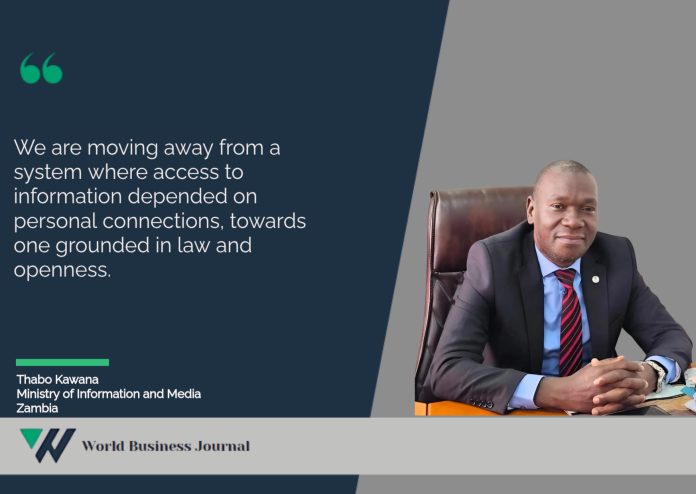
Thabo Kawana Explains Media Reforms, Access to Information and Electoral Transparency in Zambia
World Business Journal speaks with Thabo Kawana, Permanent Secretary in the Ministry of Information and Media, Zambia, on media freedom, access to information reforms, and the country’s evolving information ecosystem.
Q: How have the Access to Information Act and the repeal of the Defamation of the President law practically improved citizens’ ability to access public information, engage with government institutions, and participate more freely in national discourse?
These reforms have empowered citizens by providing a clear legal framework for accessing public information, strengthening transparency and accountability. We are also witnessing increased civic engagement, with citizens, journalists, and civil society organisations playing a more active role in scrutinising public policy and service delivery. Equally important, the repeal of the defamation law has created a more open environment for freedom of expression, enabling individuals to speak freely while remaining within the bounds of the law.
Q: How would you characterise Zambia’s media environment today in terms of independence, transparency, and operational freedom compared to previous years?
Editorial independence has strengthened, and interference in media operations has reduced. Information flows between government and the media have become more transparent, supported by efforts to professionalise communication in public institutions.
Since the UPND administration took office, no media house has been shut down, unlike earlier years when closures of television, radio, and newspaper outlets were more common.
The focus has shifted from restriction to capacity building through institutions such as the Independent Broadcasting Authority.
Q: In many countries, the challenge is often less about legislation and more about enforcement culture. How would you describe the institutional culture surrounding media freedom and information access in Zambia today?
We are moving away from a system where access to information depended on personal connections, towards one grounded in law and openness. Public institutions are increasingly adopting a proactive disclosure mindset rather than a reactive one.
This shift is being supported through training of public officers, development of internal guidance on information sharing, and strengthened accountability mechanisms. While the transformation takes time, the direction is clear: towards openness, professionalism, and service to citizens.
In practice, trained officers across ministries are expected to respond to information requests promptly, often within hours or a few days, depending on the nature of the request.
Q: Looking ahead, what do you see as the biggest remaining challenge in building a fully open, trusted, and inclusive information ecosystem in Zambia?
The biggest challenge is building a fully trusted information ecosystem where citizens have confidence in both the source and accuracy of information. We are coming from decades of treating information as a secret, and now we have opened it to the public.
That shift requires a change in mindset within the public service, but also among citizens, who must understand that access to information is now a right.
Q: As Zambia moves closer to future electoral cycles, what measures are being put in place to ensure equitable media access, responsible digital communication, and public trust in the flow of election-related information?
We are taking deliberate steps to safeguard the integrity of the information environment during elections. These include ensuring equitable access to media platforms for all political actors, promoting responsible digital communications during campaigns, working with stakeholders to counter misinformation and disinformation, and strengthening coordination with electoral regulatory bodies.
You may have heard that we recently raised concern over a campaign song that contained false information and hate speech, and action was taken through the IBA to have it censured. The promoters were asked to withdraw and edit it, removing the offensive content while retaining the non-harmful parts. That is the environment we want to build — a clean space where political actors focus on what they offer to the people rather than misinformation or personal attacks.
Zambia has held peaceful elections over the years, with transitions of power from UNIP to MMD, PF, and now UPND, without loss of life linked to elections.
Our objective is to support a peaceful, transparent, and credible electoral process where citizens make informed decisions based on each party’s manifesto, not on falsehoods or personal attacks.


