


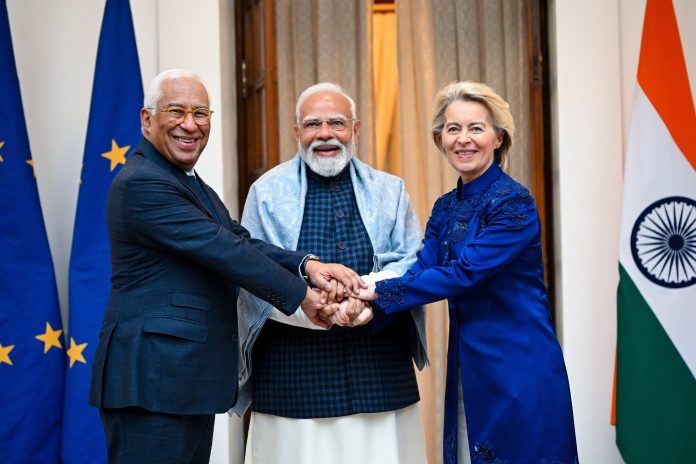
India and EU Sign Landmark Free Trade Agreement, Implementation Expected by 2027
New Delhi / Brussels – India and the European Union (EU) have concluded 20 years of negotiations for a Free Trade Agreement (FTA), marking a strategic milestone in one of India’s most important economic partnerships. Designed as a modern, rules-based trade framework, the FTA aims to tackle contemporary global challenges while enabling deeper market integration between the world’s 4th-largest and 2nd-largest economies.
The combined market of India and the EU is estimated at over INR 2,091.6 Lakh Crore (USD 24 trillion), presenting significant opportunities for the 2 billion people in both regions. The agreement is expected to unlock unprecedented market access for more than 99% of India’s exports by trade value, while safeguarding sensitive sectors and reinforcing India’s developmental priorities. (Ministry of Commerce, India)
Bilateral merchandise trade between India and the EU reached approximately INR 11.5 Lakh Crore (USD 136.5 billion)in 2024‑25, with India exporting around INR 6.4 Lakh Crore (USD 75.85 billion) to the EU. Trade in services between the two regions stood at INR 7.2 Lakh Crore (USD 83.1 billion) in 2024. (European Commission Trade Report, 2025)
A 20-Year Journey to the FTA
Negotiations for the India–EU FTA began in 2007, with multiple rounds spanning over two decades, reflecting the complexity of aligning two major economies with diverse markets, regulatory frameworks, and sectoral priorities. Discussions focused on market access, rules of origin, tariffs, services, agriculture, and investment protections. (Ministry of Commerce, India; European Commission)
The official announcement of the concluded negotiations was made during the India–EU Summit on 27 January 2026. While this signals the end of negotiations, the treaty is not yet legally in force. The final legal text must undergo legal review, translation, and parliamentary ratification in both India and the EU before implementation. (Times of India, 2026)
Timeline: From Signing to Ratification and Implementation
-
27 Jan 2026 – Negotiations concluded at India–EU Summit (announcement of procedural agreement)
-
Mid‑2026 – Legal review, drafting, and translation of treaty text (Asianet Newsable, 2026)
-
Late 2026 – Formal signature expected after final approvals
-
Early 2027 – FTA anticipated to enter into force, enabling tariff reductions and market access
Empowering Businesses and Securing Future through Market Access
India gains preferential access across 97% of tariff lines, covering 99.5% of trade value. Key highlights:
-
Immediate duty elimination for 70.4% of tariff lines, covering 90.7% of India’s exports in textiles, leather, footwear, tea, coffee, spices, sports goods, toys, gems and jewellery, and marine products
-
Phased duty elimination over 3–5 years for 20.3% of tariff lines covering 2.9% of India’s exports (marine products, processed foods, arms, and ammunition)
-
Tariff reductions/TRQs on 6.1% of tariff lines covering 6% of exports (poultry, bakery products, cars, steel, certain shrimps/prawns)
This preferential access is set to enhance competitiveness, integrate Indian MSMEs into European value chains, and create employment opportunities in labour-intensive sectors. (Ministry of Commerce, India)
India’s offer includes 92.1% of its tariff lines, covering 97.5% of EU exports, with immediate and phased duty eliminations, including select TRQs for fruits. Importing EU high-tech goods will diversify India’s sources, reduce input costs, and foster integration into global supply chains.
Agriculture, Services, and Talent Mobility
-
Agriculture: Preferential access for tea, coffee, spices, grapes, cucumbers, onions, and processed foods is expected to strengthen rural incomes and enhance competitiveness, while sensitive sectors like dairy, cereals, and poultry are safeguarded. (Ministry of Commerce, India)
-
Services: The FTA covers 144 EU services subsectors, including IT/ITeS, professional services, and education. India’s offer covers 102 subsectors, providing EU businesses a predictable regime to operate in India.
-
Talent Mobility: The FTA allows temporary entry for professionals, Intra-Corporate Transferees, contractual service suppliers, and independent professionals, enabling India to strengthen its global talent footprint.
Sectoral Gains: Unlocking India’s Export Potential
-
Textiles & Apparel: Zero duty across all tariff lines, boosting India’s INR 3.19 Lakh Crore global exports and increasing access to the EU’s USD 263.5 billion import market
-
Leather & Footwear: Tariff elimination on exports valued at INR 20.9 Thousand Crore (USD 2.4 billion)enhances EU market access
-
Marine Products: Preferential access for shrimp, frozen fish, and value-added seafood, supporting India’s blue economy
-
Engineering & Chemicals: Tariff reductions boost exports, strengthen MSME clusters, and enhance global competitiveness
-
Jewellery, Plastics & Rubber, Home Décor: Preferential access supports employment, innovation, and sectoral growth (Ministry of Commerce, India; European Commission)
This FTA signals a modern, multifaceted India–EU partnership, offering a stable environment for exporters, robust market access, and growth opportunities across sectors while aligning with domestic priorities and global trade standards.


