


Ernest Rubondo Discusses How Flagship Energy Projects Are Driving National Growth and Local Industry Capacity
World Business Journal talks to Ernest Rubondo, Executive Director of the Petroleum Authority of Uganda, about the significant progress made on the four flagship projects in the oil and gas sector and the role of the regulatory framework in fostering national development, facilitating knowledge transfer, and creating employment opportunities within the industry.
What are the latest developments in Uganda’s oil and gas sector?
Uganda’s oil and gas sector features 4 key flagship projects: the Tilenga and Kingfisher Petroleum Production Projects, the East African Crude Oil Pipeline (EACOP), and the Refinery Project.
The Kingfisher project is operated by CNOOC Uganda, includes 4 oil fields and is planned to have over 30 wells drilled for its production. The total investment for this project is estimated at $2B. 13 out of the 15 wells required for commencement of oil production from the Kingfisher oil field have been drilled, and the project is now about 60% complete and is expected to reach a peak production of approximately 40,000 bpd.
The Tilenga project is operated by TotalEnergies, consists of 6 oil fields and is planned to have over 400 wells drilled for its production. The total investment for this project is estimated to be $5B. To date, over 107 of the 180 wells required for first oil have been drilled using 3 rigs. The project is approximately 48% complete and is expected to reach peak production of 190,000 bpd.
The acquisition of land for both the Kingfisher and Tilenga projects is now complete, and all affected individuals have been fully compensated.
The 1,443 km, 24-inch diameter East African Crude Oil Pipeline (EACOP) runs from Hoima in Uganda to Tanga in Tanzania and is estimated to cost $5B. EACOP Ltd is developing the project, with TotalEnergies holding 62% ownership stakes, CNOOC at 8%, TPDC at 15%, and UNOC at 15%. The EACOP project has 5 camps in Uganda and 12 in Tanzania, along with 6 pump stations (2 in Uganda and 5 in Tanzania). At the end of May 2025, over 70 km of line pipe had been connected on the Ugandan side, while over 200 km had been connected on the Tanzanian side of EACOP. The pipeline project’s land acquisition has reached 98%, while the overall project progress stands at 62%.
The 60,000-bpd crude oil refinery at Kabalega Industrial Park in Hoima District is planned to be developed by the Uganda Refinery Holding Company (URHC), a subsidiary of UNOC, with an estimated investment of $4B. The government of Uganda and the National Oil Company concluded an implementation agreement with Alpha MBM during April 2025 for investment in the refinery, thus paving the way for the commencement of pre-construction and subsequently construction work, which is expected to take 3 years.
What impact have regulations had on national development, knowledge transfer, and the integration of the oil and gas sector with other economic sectors?
Currently, the oil and gas industry directly employs close to 17,000 people, with 90% being Ugandans. An additional 150,000 indirect and induced jobs have been created, bringing the total jobs created by the industry close to 200,000. Ugandans occupy 64%, 85%, and over 99% of the management, technical, and support roles in the country’s oil and gas sector.
The government has worked with the private sector to enable 15 vocational institutions to attain globally recognised certifications in the oil and gas industry. 14,000 Ugandans have received training and achieved international certification in trades like welding, plumbing, scaffolding, etc.
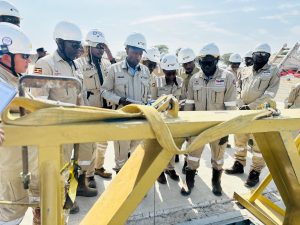
Over 2000 micro, small, and medium-sized enterprises have had their capacity built in areas of bidding and financial management, together with aspects of HSE. The key objective of this capacity building has been to enable them to secure and implement contracts to provide goods and services in the sector.
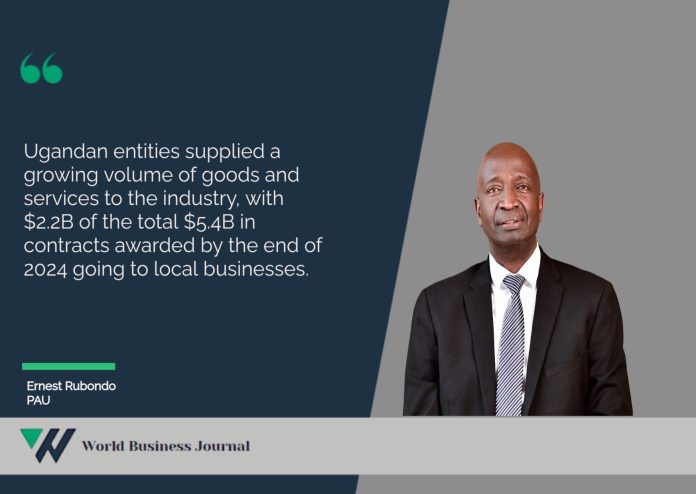
Ugandan entities supplied a growing volume of goods and services to the industry, with $2.2B of the total $5.4B in contracts awarded by the end of 2024 going to local businesses.
Joint ventures between Ugandan and international entities are key avenues for supporting technology transfer in the sector. As of the end of 2024, we have approved nearly 150 joint ventures, and 35 of these have secured contracts worth $338M.
The government has conducted studies to identify linkages between the oil and gas sector and key sectors of Uganda’s economy, such as agriculture, tourism, banking, transport, health, and education. Properly harnessing these linkages could generate an additional $8B in value from oil and gas activities.


