


PS Irene Batebe on Uganda’s Energy Expansion, Refinery Progress and Mining Resource Strategy
World Business Journal talks to Irene Batebe, Permanent Secretary at the Ministry of Energy and Mineral Development, about the ambitious goal of achieving 52,000 MW of generation capacity by 2040, the importance of quantifying mineral resources, the advantages of the new 60,000 bpd refinery at Kabaale, and the vast investment opportunities within the mining sector.
Can you provide an overview of the ongoing hydro, solar, and nuclear energy initiatives aimed at reaching 52,000 MW by 2040?
The 2023 energy policy aims to boost generation capacity from 2,051.6 MW to 52,000 MW and achieve universal electricity access, currently at 60%. We plan to diversify our generation—currently 93% hydropower—by adding 28,000 MW from solar, bioenergy, and gas, along with 24,000 MW from nuclear.
We are advancing three hydropower projects on the River Nile: Ayago, Kiba, and Oriang. In geothermal, we aim to unlock 4,500 MW through exploration in Western Uganda, particularly near Kikube and the Pakwach Basin. We are finalising a grid stability study for solar integration and developing mini-grids for remote areas.
In collaboration with the IAEA, our nuclear programme includes preparatory studies and design work. We are also enhancing transmission through a new grid development plan and regional interconnections via the East Africa Power Pool.
The Electricity Access Scale-up Project (EASP), in collaboration with the World Bank and other projects, intends to increase the number of connections from 2.3 million to 4.3 million over the next three years.
Supporting local companies in supplying goods like transformers and meters will boost the economy. Our focus includes advancing energy efficiency, managing demand, and promoting alternative cooking solutions such as liquefied petroleum gas and biogas, while ensuring the sustainable use of biomass to address energy transition challenges and resource depletion holistically.
How is the mineral exploration programme aimed at quantifying mineral resources progressing?
The mineral exploration programme is advancing as a core objective of NDPIV, focusing on quantifying resources such as iron ore, gold, copper, lithium, and nickel. With increased government financing and the establishment of a new national mining company, we are optimistic about tapping into the country’s mineral potential.
A specific project has been approved through a production sharing agreement with Sarrai Group that will hold 85% and the Ugandan National Mining Company 15%. This partnership aims to enhance exploration, especially in copper, while the government manages most of the quantification to ensure accurate data for investment.
What advantages will the Kabaale (Hoima) oil refinery project provide for the region’s energy security?
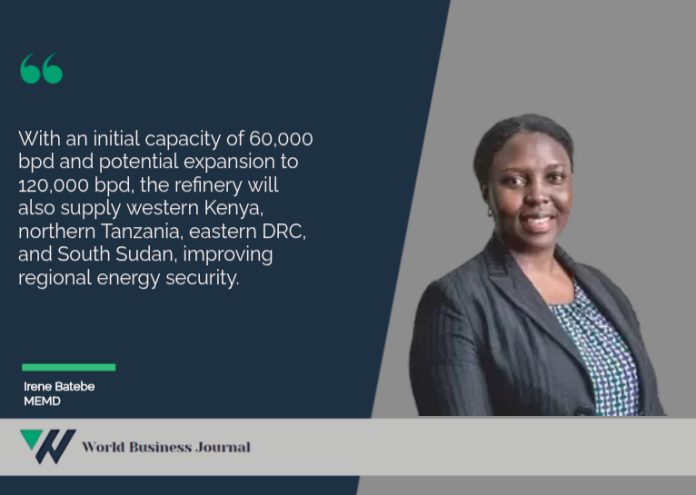
The refinery project, initiated due to oil discovery and regional demand for petroleum products (around 250,000 bpd), is essential as regional refineries in Mombasa and Tanzania are closed, creating supply insecurity. With an initial capacity of 60,000 bpd and potential expansion to 120,000 bpd, the refinery will also supply western Kenya, northern Tanzania, eastern DRC, and South Sudan, improving regional energy security. The project is financially viable, offering a 15% to 20% return on investment. Funded through a 100% equity model, the Uganda National Oil Company (UNOC) will contribute 40% and Alpha MBM Investments 60%. The estimated cost is $3-$4B, with UNOC expected to mobilise $1.2 bn to $1.6B over 3 years, ensuring a sustainable fuel supply for Uganda and the region.
What investment opportunities are available for investors in the mining sector?
Investors can explore opportunities in gold, iron ore, rare earth elements, copper, nickel, manganese, chromite, lithium, and uranium, among others.
The airborne geophysical survey for Karamoja and Kadam-Moroto has identified significant mineral resources. There are opportunities in beneficiation and value addition projects, with 9 gold refineries and expanding tin and iron ore smelting plants. To assist investors, an online mining cadastre system has been established, serving as a primary resource for engagement with us.


